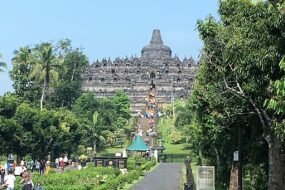
Borobudur Temple
Borobudur Temple, sebuah keajaiban arsitektur di Jawa Tengah, Indonesia, merupakan situs utama karena keunikan dan arsitektur arkeologinya yang indah. Kuil ini bersama Pawon dan Mendut membentuk kesatuan sakral, dibangun oleh Dinasti Syailendra sekitar abad ke-8 dan ke-9 Masehi, dan semuanya terletak dalam satu garis lurus di Dataran Kedu yang subur.
- Tiga candi Buddha di wilayah tersebut, yaitu Borobudur, Pawon, dan Mendut, terletak dalam satu garis lurus.
- Ketiga candi tersebut dibangun pada masa Dinasti Syailendra sekitar abad ke-8 dan ke-9 Masehi.
- Candi Borobudur terletak sekitar 40 kilometer (25 mil) barat laut Yogyakarta, di dataran tinggi antara dua gunung berapi kembar dan dua sungai.
Borobudur Temple is the most Highlight in Java island, even Indonesia, for the uniqueness and the beautiful archaeological architecture. During restoration of Borobudur Temple in the early 20th century, also was discovered that three Buddhist temples in the region, Borobudur, Pawon and Mendut, fall on a straight one line. This may be coincidence, but is in agreement with a native folk tale that there was an ancient brick road from Borobudur to Mendut with walls on both sides. The three temples have similar architecture and ornamentation, which suggests a ritual relationship between them to form a sacred unity, although the exact ritual process is unknown.
Borobudur Temple Compounds is the World Heritage designation of the area of three Buddhist temples in Central Java, Indonesia. It comprises Borobudur, Mendut, and Pawon. The three temples were built during the Shailendra Dynasty around the 8th and 9th centuries CE, and fall on a straight line.
Approximately 40 kilometres (25 mi) northwest of Yogyakarta, Borobudur Temple sits on a plateau between two twin volcanoes, Sundoro-Sumbing and Merbabu-Merapi, and two rivers, the Progo and the Elo. According to local myth, the area known as Kedu Plain is a Javanese sacred place and has been dubbed ‘the garden of Java’ due to its high agricultural fertility.
FAQ (Pertanyaan Umum)
Apa yang membuat Candi Borobudur istimewa?
Candi Borobudur dianggap sebagai daya tarik utama di Pulau Jawa, bahkan Indonesia, karena keunikan dan keindahan arsitektur arkeologinya. Selain itu, candi ini, bersama dengan Candi Pawon dan Mendut, membentuk satu kesatuan sakral yang terletak dalam satu garis lurus.
Kapan dan oleh siapa Candi Borobudur, Pawon, dan Mendut dibangun?
Ketiga candi tersebut — Borobudur, Mendut, dan Pawon — dibangun pada masa Dinasti Syailendra sekitar abad ke-8 dan ke-9 Masehi.
Di mana lokasi geografis Candi Borobudur?
Candi Borobudur terletak sekitar 40 kilometer (25 mil) barat laut Yogyakarta, di dataran tinggi antara dua gunung berapi kembar, Sundoro-Sumbing dan Merbabu-Merapi, serta dua sungai, Progo dan Elo.
Baca juga: Airport Greeting Service


